Right to Boycott – new model motion for CLPs

As part of the ongoing crackdown on our civil liberties, the Government is reported to soon be bringing forward much anticipated “anti-boycott” legislation, which had already been opposed by 46 civil society groups in anticipation of the announcement.

In particular, the Government is seeking to take away from public bodies the right to decide not to purchase or procure from, or invest in companies involved in human rights abuse, abuse of workers’ rights, destruction of our planet, or any other harmful or illegal acts.

This “anti-boycott” Bill is in line with the Conservative Party’s last manifesto, which outlined an intention to introduce legislation to prohibit public bodies from imposing their own direct or indirect boycott or divestment campaigns against foreign countries when the Government does not agree.

The direct nature of this attack on the international “boycott, divestment and sanctions” (BDS) demands of the movements around the world in solidarity with the Palestinian people is obvious, but of course the nature of the attack stretches far wider than that issue alone, effecting climate activists, all international solidarity campaigns, trade unions and many others.

Furthermore, it is not just a question of supporting BDS being under attack, but whether people even have the right to discuss it and make their own decisions.

For these reasons, Labour & Palestine and the Palestine Solidarity Campaign have jointly drafted a model motion for local Labour parties to discuss defending our right to boycott and urging the Labour front bench to oppose this anti-democratic bill, which is copied in full below and can be downloaded here. Please take this to your next local meeting for discussion.

It is a moral and human right to conscientiously object to having our money used to buy or sell or invest in goods and arms being used by Israel to wage war on the Palestinian people. That is why Labour must oppose the Government’s proposed bill to outlaw the right to boycott and we hope you will be able to pass the motion. If you have any questions, please don’t hesitate to get in touch.


New Model Motion: Defend the Right to Boycott

This CLP Notes:

  • The government’s Foreign Affairs (Economic Activities of Public Bodies) bill, or anti-boycott bill, will limit the ability of public bodies to make ethical choices about spending and investment that reflect widespread public support for human rights, climate goals and international law.
  • The bill will shield companies engaged in human rights abuse or environmental destruction by preventing public bodies from cutting financial ties with them over abusive or illegal actions committed in a foreign state, unless expressly permitted to do so by the government.
  • Many companies who are involved in the abuse of human and workers’ rights, the destruction of our planet, and other illegal and harmful acts are not subject to government sanctions.
  • The Tories have indicated that a major reason for proposing this law is specifically to prevent public bodies from deciding not to invest in companies operating in Israel and occupied Palestine – even if they are complicit in the violation of international law and the human rights of the Palestinian people.
  • A wide range of civil society organisations such as trade unions, charities, NGOs, faith, climate justice, human rights, cultural, campaigning, solidarity organisations and others are opposing this bill.

This CLP Believes:

  • Labour must oppose this. Public bodies and democratic institutions should be able to spend, invest and trade ethically in line with international law and human rights.
  • From bus boycotts against racial segregation to divestment from fossil fuel companies to arms embargoes against apartheid, boycott, divestment, and sanctions are non-violent campaigns that have been applied throughout history to put economic, cultural, or political pressure on a regime, institution or company to force it to change abusive, discriminatory, or illegal policies.
  • Labour Party Conference motions have repeatedly called for real and effective action in support of Palestinian rights.

This CLP Resolves:

  • To send this motion to the Labour NEC and relevant front bench members.
  • To support those in civil society mobilising in support of the right to boycott and divest.
  • Invite a speaker from the Right to Boycott campaign to our next meeting.
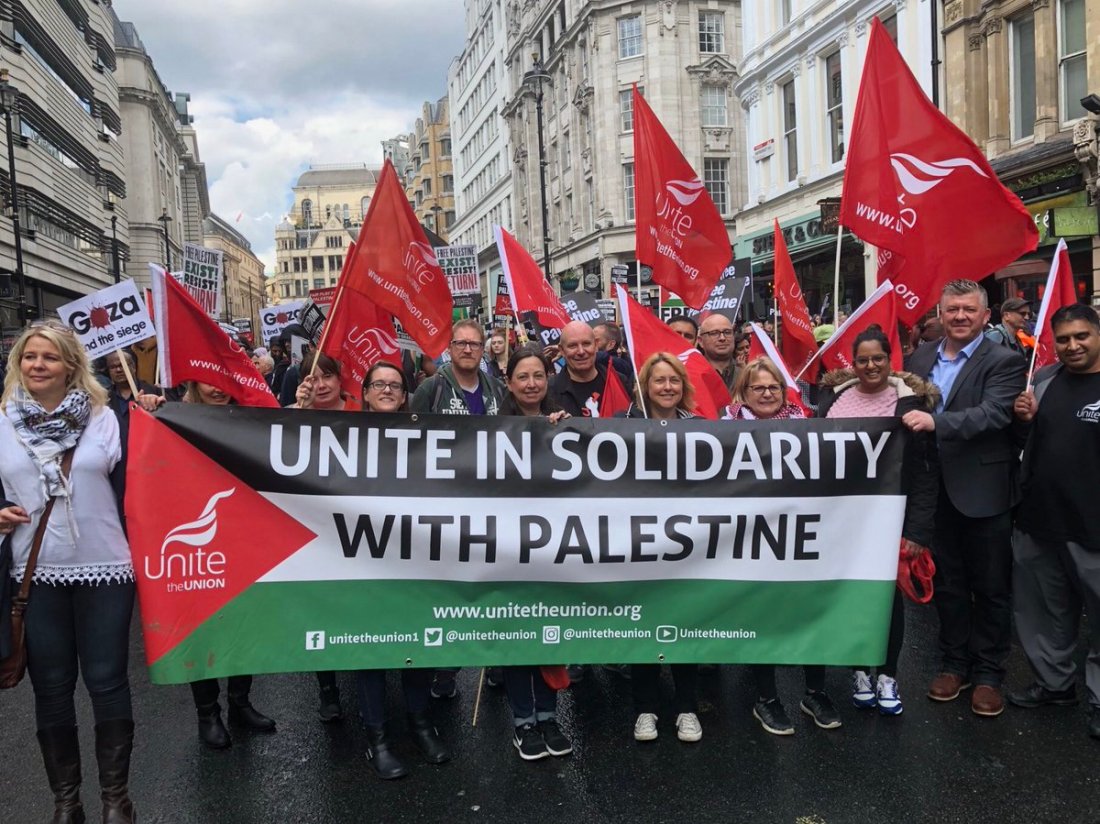
Stand in solidarity with the Palestinians – Clare Baker, Unite the Union

By Clare Baker, International Department, Unite the Union & Labour & Palestine.

My trade union UNITE has always been at the forefront of building solidarity with the Palestinians.

We regularly send and participate in delegations to Palestine to see the reality on the ground and to build relations with the people who need our support. We also support the PSC and have some fantastic twinning groups with communities in Palestine and our own community sector – such as with the Shu’fat refugee camp and the Lydd London solidarity group. Along with a number of other trade unions we’ve also been very much behind the initiative that established the Labour & Palestine platform – to give a voice for grassroots support for Palestine within the labour party,

As we know, the situation on the ground is getting more and more desperate for the Palestinians. This new Israeli government is the most right-wing in its history, but we need to be clear that they are only continuing the policies of previous governments.

However now they are being very open about their motives, and they are no longer hiding behind the veneer of a so-called democracy – that was never ever a democracy if you were Palestinian.

It is good to see that there is some push back against this new government.  

But we also must ask where were the appalled expressions over the many years when the rights of Palestinians were trampled on, and over the illegal occupation?

The horrific attacks that we have seen since the beginning of the year, the terrorism that the state and settlers unleash against Palestinians, is quite astonishing to witness. From the attacks by the Israeli military in Jenin and Nablus to attacks by settlers (with the protection of the Israeli military) in Huwara – we see the complete destruction of homes and property and the loss of life.

We listen with horror at members of the new Israeli government publically talking about ethnically cleansing and expelling all Palestinians to Jordan, annexing parts of the West Bank, introducing a shoot to kill policy and even vocally expressing the wish that the state should wipe entire Palestinian towns off the map.

We also see the increasing criminalisation ofoppositionto Israeli government policies, such as the closing down and criminalisation of the 6 NGOs in Israel that fought for human rights.

The criminalisation of any opposition to far-right regimes and their policies of oppression and violence is a trend that we in Unite are seeing more and more in our international work. Calling aid workers, lawyers, teachers, opposition politicians and trade unionists terrorists is a tactic being used to great effect – with no international condemnation – by many states that are becoming more and more extreme.

And the response by the international community, many politicians and in particular by the UK government is one of silence – this is an absolute outrage and frankly hypocritical when it is so vocal in calling out Russia (quite rightly) for their crimes – but where the world’s governments reacted quickly and decisively and have committed to sanctions and boycotts of Russia, when it comes to the Israeli occupation and crimes against the Palestinians our government and many others are silent.

Not only is this hypocritical of the UK government when it plans to attack the right to boycott, but also by governments doing nothing the Israeli state is given a green light to continue their suppression, ethnic cleansing, and implementation of apartheid against the Palestinians.

UNITE fully supports the peaceful campaigning of the BDS movement as called for by the Palestinian civil society – just as we supported the BDS movement against apartheid South Africa as called for by the people there.

The BDS campaign is growing and getting stronger and is having a serious impact, which is why the Israeli government have poured huge amounts of money and resources into fighting it globally around the world and why the Tories are looking to introduce the anti-BDS law.

First and foremost, we need to be clear that this law represents a fundamental attack on basic democracy and peoples’ civil rights and should be viewed in the context as well as of the suite of Tory repressive legislation – such as that to restrict protestors and to attack the right to strike.

Although the law is primarily being proposed in order to stop the BDS campaign against Israeli apartheid, it will likely be written in a way that applies across the board – meaning that any similar BDS actions we might want to take in relation to say Turkey – a state that also occupies and ethnically cleanses, will be outlawed as well because the line of the Foreign Office is currently very pro-Turkey. Or, as we have already seen in the US anti-BDS legislation in certain states is used to silence those who campaign, for example for women’s reproductive rights, against fossil fuels and against guns – we need to understand that this is the thin end of the wedge and that they will go further if we don’t stop them now.

And can you imagine if this law had been in force back when South Africa was still an apartheid state? When Thatcher supported that regime and called Mandela a terrorist? It would have meant no local authorities or public institutions could have joined the boycott, sanctions, and divestment campaign to defeat that disgusting regime.

The situation that faces Palestinians is deteriorating rapidly, the international community cannot stand by and watch an extremist racist government ethnically cleanse, oppress and commit the crime of apartheid against the Palestinian people with no consequence. Because, to keep excusing this, to stay silent or to continue to do business in the illegal settlements means that these international states or companies are complicit in every terrorist attack by the state or settlers that kills Palestinians, ethnically cleanses them from their homes and forces them to live in a system where they are discriminated against because of their race.

Within the Labour Party there is clear policy that was passed unanimously in 2021, that built on the position adopted at the 2020 TUC conference. It references the Human Rights Watch and B’Tselem reports and calls for effective measures including sanctions to be implemented in order to address Human rights abuses. And despite the leadership wanting to pretend the motion doesn’t exist and having no intention to act – the reality is – the motion was passed, and it does exist – and I applaud the work of Labour and Palestine in helping CLPs have the confidence to hold discussions within the framework of the motion as labour party policy.

Labour and Palestine have done a really good job in raising the plight of the Palestinian people within the Labour Party, and we will continue to do so, despite the difficult atmosphere that exists. But it really is high time now that the Labour Party as a whole, particularly the Labour Party leadership, starts making it crystal clear on where it stands in relation to this new far right Israeli Government and some of the appalling actions and decisions that are being taken and implemented. The Labour Party must always stand in solidarity with those facing the worst oppression, and where can the need for this be clearer today than to stand in solidarity with the Palestinians?


  • March for Palestine on Saturday May 13 – RSVP for Labour bloc here  & see full details here.
  • Move the Labour & Palestine motion on Supporting Palestinian Human Rights at your local meeting – see here.
  • Support the Right to Boycott against upcoming Tory attacks – show support here & read more here.
  • This piece was originally published by Labour & Palestine and was based on a speech given at L&P’s recent Labour Women Speak Up for Palestine event.

Supporting Palestinian Human Rights – new model motion

Please take this model motion to your Labour Party meeting. It can also be downloaded here.

MODEL MOTION: SUPPORTING PALESTINIAN HUMAN RIGHTS

This CLP notes:

The increasing violent reality in occupied Palestine. In February 2023, Amnesty
International argued that Palestinian lives are in peril due to the increasingly
aggressive policies of the new Israeli Government.

This includes Israeli authorities constantly demolishing Palestinian homes whilst
settlements, considered illegal under international law, are aggressively expanded.

Amnesty also noted that of those who have died in the last year, 220 Palestinians,
including 35 in January 2023 alone, had been killed by Israeli forces.

The UK continues to sell weapons to Israel which are then used in human rights
violations.

The international criminal court has launched an investigation into alleged war
crimes in the Palestinian territories.

This CLP believes:

That Israel is using laws and policies to suppress opposition and resistance to its
military occupation.

That part of a genuinely ethical foreign policy for Labour must include security
justice, dignity and human rights for the Palestinian people.

International solidarity can play an important role in highlighting the plight of the
Palestinian people, including in terms of calling for an end to arms sales to Israel.

This CLP resolves:

To invite a speaker from Labour & Palestine to address a future meeting on the
current situation with regards to Palestine.

To send this motion to the Labour Party leader and Shadow Foreign Minister urging
them to speak up in support of international law and human rights for all

Palestine – what does a Labour ethical foreign policy look like?

By Hugh Lanning, Labour & Palestine

The election of Israel’s most right-wing Government ever under the resurrected Netanyahu makes yet more important the reaction of the international community. Is there ever going to be a tipping point when Western governments stand up to Israel’s pressure and say ‘enough is enough?’ Judging by the response of the British Labour Party in recent times, the prospects are not good.

Much lip-service is paid to an ethical foreign policy – dating back to Robin Cook’s honourable attempt at developing such an approach in the late 1990’s. So, what would an ethical Labour foreign policy look like? The cynical would say that the first challenge for Labour would be to have ethics and secondly a policy. In contrast, the Tories have both, namely the self-preservation of Western neo-liberal globalisation – or to put more simply – to look after the rich and their interests.

Palestine would not be the central or sole focus of an ethical foreign policy, but it should be both a priority and a litmus test. If a Labour ethical foreign policy can’t tackle or encompass Palestine, then it is not fit for purpose. Simply doing what the US, Israel, the City and the far-right want doesn’t work or pass any test by which Labour should behave, although you could easily think that is where the Party is taking its lead from.

A truly ethical foreign policy would have three pillars – ethics, decolonisation and non-violence. First, ethics – the basis should be to use international law as the ethical framework. It might be nice to contemplate alternatives, be it revolutionary or socialist, but as a first step international law is a low bar to which Labour should aspire to advocate.

In doing this Labour should take account of the nature and scale of the breach – not cherry-pick the popular or the easy. Nor will it be able to respond to every and any type of breach. But, using Israel as an example, its list of breaches is long, extensive and serious – the Occupation itself, the Wall, Settlements, the annexation of Jerusalem, its treatment of children and prisoners and the growing evidence of it being guilty of the crime of apartheid.

However, we should recognise that international law is a Western, orientalist construct – so how do you select how and where to act? A frequent question from supporters of Israel is ‘why Palestine?’ – why don’t you pick other countries?

Therefore, the second pillar of an ethical foreign policy should be De-colonisation – a principle to determine how and when to be pro-active and possibly intervene. Blair developed the concept of ‘humanitarian intervention’, which went from Kosovo, through Sierre Leone to Afghanistan, ending up in Iraq.

The problem with such a framework is that it is the West determining how, where and when to intervene. De-colonisation has been described as “deconstructing and dismantling neo-colonial ideologies regarding the superiority of Western approaches and working toward a redistribution of power that was accrued because of colonisation”. We should use decolonisation to determine whose side we are on and whose solution we support – is it positive or negative on that scale of the redistribution of power?

In addition, it is important to take into account what the British role has been and what the colonial legacy is. In the case of Palestine, we ruled it between the wars, gave it away from Balfour onwards, stood by whilst the Nakba took place and armed and financially supported Israel then and now. If we owe reparations to any country – Palestine is high up that list.

It should not be our solution, but to support outcomes wanted by the self-determined, indigenous groups – in this case by the Palestinians. Self-determination being pre-eminent, it could take many forms – aid, trade or maybe keeping away, not supporting its oppressors.

Blair’s doctrine was used as a justification for war, which leads to the third pillar of an ethical foreign policy – non-violent methods. Solutions should not be based on force and military interventions. South Africa showed what can be done – there are a wide range of options that can be used. In a globalised economy there are plenty of sanctions and economic levers that can be applied, as is called for under international law.

It is not for nothing that Israel is targeting and trying to demonise the international growing ‘boycott, divestment and sanctions’ campaigns – it is because they are potentially effective non-violent methods that could be used to bring about compliance with international law. BDS should be applied, not banned. We are a rich western country, that doesn’t mean we should aspire to be a global, military power spending billions of much-needed resources on what we euphemistically call ‘defence’.

In considering what is to be done, it is also important to consider what is doable, what is the UK role, and what are the priorities. But principles alone are not enough, it is not simply having the right policy. We need to build a mass movement within and without the Labour Party that would support a government taking a radical approach. We saw during Truss’s brief reign the powers that can be unleashed when the British establishment feels its interests are threatened.

Labour & Palestine is building and seeking to energise pro-Palestine support within the Labour Party. Our challenge is to both win support for a progressive ethical foreign policy and, then, to keep up the pressure to have it implemented. Palestine shows the problem is not a Labour Government being too radical, rather it is it walking away and ignoring the issue. The passing of resolutions at successive party conferences and in many CLPs has shown that the support is there within the Party. Over the coming months Palestinians are going to need support to combat the onslaught they are facing from a rampant colonial settler movement intent on stealing their land, heritage and freedom.


Eyewitness Palestine: For justice, for freedom & for the right of return – Louise Regan

Louise Regan reports on two recent solidarity delegations to Palestine.

In October and December 2022, I returned to Palestine, the first time since February 2020 due to Covid19. On both visits I was with other trade unionists, most who had not visited before and who were there to learn more about the situation, and to meet with individuals and organisations to deepen their understanding.

For Palestinians 2022 was the deadliest year since 2006. The monthly average of Palestinian fatalities increased by 57 per cent when compared with 2021. In the first half of October alone 15 Palestinians, including six children, were killed by Israeli forces during search-and-arrest operations, exchanges of fire, or in confrontations between Israeli forces and Palestinians in the West Bank including East Jerusalem.

In October we visited Nablus, a beautiful city in the West Bank. Nablus had been under curfew for several days and entry in and out was severely restricted. We have good links with the cultural centre in the camp and although there was clear evidence of clashes at the entrance to the town we made our way in with no problems. During our time in the camp it was clear that the situation was stressful for them.

As we left several armed vehicles arrived and we were questioned about the purpose of our visit. The following day four young Palestinians were killed in the camp – these were young people with hopes and dreams, young people who just wanted to enjoy their life but who are now gone forever.

Mural of murdered Palestinian journalist Shireen Abu Aqleh. Photo credit: Louise Regan

We also visited Aida Refugee camp in Bethlehem. Aida is the most tear gassed place on earth. The families there live under the eye of numerous military watchtowers and regular incursions in to the camp not only firing tear gas and skunk water but also arresting young people in the middle of the night. At the edge of the camp is the Lajee centre set up in April 2000, the centre is a sanctuary for the children and young people of the camp.

They have developed an outdoor play area, football pitch, a nursery and gym and they run music, dance and creative workshops. On the roof of the centre there is a garden area with a hydroponics greenhouse where they are growing and distributing fresh herbs and vegetables.

In December we met with representatives from Addameer and DCI Palestine. Two of the human rights organisations who have been categorised as terrorist groups by the Israeli state, a political decision with no evidence or justification being presented. Both organisations, along with four others, have had their offices raided and documentation and computers stolen.

DCI Palestine advocates for child prisoners. Most Palestinian children are arrested during the night in armed raids on their home. They are blindfolded, shackled and taken in military jeeps to detention centres where they face interrogation and torture. They are tried in military courts and regularly forced to sign confessions written in Hebrew, a language they do not speak. Their crime – throwing stones – a crime for which they can face up to ten years in prison or twenty years if they hit a vehicle. Addameer advocates for political prisoners who face administrative detention, a system put in place during the British mandate, where they can be detained without charge or trial for an indefinite amount of time.

I have visited Palestine many times and I am always in awe of the people, their sumud ‘steadfastness’ and their resilience against the oppressive regime under which they live. The ongoing occupation, the human rights abuses they face on a daily basis limiting their ability to work, to access their own lands and family, to attend medical appointments or even go to school are all truly shocking and something that once you have seen you cannot un-see.

On the 2nd November 1917 British Foreign Secretary Arthur Balfour issued the Balfour Declaration which stated:

‘His Majesty’s Government view with favour the establishment in Palestine of a national home for the Jewish people, and will use their best endeavours to facilitate the achievement of this object, it being clearly understood that nothing shall be done which may prejudice the civil and religious rights of existing non-Jewish communities in Palestine, or the rights and political status enjoyed by Jews in any other country.’

These 67 words written over one hundred years ago led to not only the mass expulsion of the Palestinian people from their homes and land but also the ongoing occupation, control and intimidation of the Palestinian people until this day.

During the last year important reports by B’Tselem, Human Rights Watch and Amnesty have all been released calling Israel an apartheid state. During all my visits I have witnessed apartheid in action – from the restriction of Palestinians freedom of movement, the segregation and control of their daily lives to the dispossession of land and property.

Roadside checkpoint sign in Palestine. Photo credit Louise Regan

On one of my first visits to Palestine I was told that Palestine was being built out of existence. What I witnessed in October and December – the huge settlement expansion, the new settler only roads cutting through the Palestinians land and the escalating house demolitions and evictions means that the reality of this statement is coming ever nearer. 

In Sheikh Jarrah when one of our union members cried after hearing about the plight of the families there – the Palestinian father we were meeting with said “we thank you for your tears but we don’t need tears – we need voices – go back and tell people what you have seen – tell them our story as we are voiceless.”

Let us all be the voice of the Palestinians, let us all speak out until we get justice and freedom for the Palestinian people.


  • You can follow Louse Regan on twitter here.
  • Join the Palestine Solidarity campaign here; and follow them on FacebookTwitter and Instagram.
  • This piece was originally published on Labour Outlook here.

Labour Must Speak up for Palestine statement – updated for UN Solidarity Day 2022

Add your name here

“To be an internationalist and democratic socialist party, it is the responsibility of the Labour Party to speak up for Palestine and stand in solidarity with the Palestinian people and their fundamental rights, including to self-determination.

Recent actions by the Israeli Government have illustrated the continuing nature of Israel’s illegal occupation and the denial of the rights of Palestinian peoples with the use of militarised violence and forced displacements. The attacks on Gaza in August 2022 killed 44 Palestinians, including 15 children, and were described by the UN Special rapporteur as an act contrary to international law. The Israeli army’s killing of the Palestinian journalist Shireen Abu Akleh; the attacks on the Al Aqsa mosque and the outlawing of 7 NGOs who spoke up for Palestinian rights being just some examples.

The seriousness of the situation facing the people of Palestine is confirmed by the fact the International Criminal Court is holding an inquiry into abuses committed in the occupied Palestinian Territories since 2014.

The continuing de facto annexation of Palestinian land by accelerated settlement building alongside statements of Israel’s continuing intention to proceed with annexation, show it is clearer than ever that the Israeli State is intent on eliminating any prospects of Palestinian self-determination, including by trying to annex Jerusalem as its sole capital.

Major reports by Amnesty International, Human Rights Watch and the Israeli human rights group B’Tselem have concluded that Israel is practising the crime of apartheid as defined by the UN.

Labour must build on – not step back from – its commitments to immediate recognition of the state of Palestine and an end to the blockade, occupation and settlements as outlined in the 2017 and 2019 manifestos, and in the motions overwhelmingly passed by the Party’s annual conferences in 2018, 2019 and 2021, the last  of which stated “that the Labour Party must stand on the right side of history and abide by these resolutions in its policy, communications and political strategy.”

We must support “effective measures” including sanctions, as called for by Palestinian civil society, against actions by the Israeli state that are illegal according to international law. This must include action to ensure that Israel stops the building of settlements, reverses any annexation, ends the occupation of the West Bank, ceases the blockade of Gaza, brings down the Wall and respects the right of refugees to return to their homes under international law.

We oppose measures designed to stop civil society using non-violent actions, including ethical investment policies, to try to ensure Israel complies with international law.”

Israeli State abuse of children’s rights shows why Labour must speak up for Palestine

On the UN International Day of Solidarity with the Palestinian People and warns of the growing concern that the Labour front bench barely speaks out at all on the issue today.

This month marks two international dates of great significance for the Palestinian people and international campaigns for their rights.

Tomorrow sees the United Nations International Day of Solidarity with the Palestinian People and November 20 was World Children’s Day.

On the latter, the Palestinian Commission of Detainees and Ex-Detainees Affairs (CDA) published shocking figures that not only show how the illegal Israeli occupation abuses Palestinian children’s human rights, but also starkly illustrate the horrific nature of life for people in the occupied territories, including under-siege Gaza.

The CDA information shows that Israel has detained over 50,000 children in the last 45 years since 1967 when Israel commenced its illegal occupation of the West Bank and East Jerusalem — and 160 children are currently being detained.

The death of Palestinian children at the hands of Israeli state forces is also a disturbingly regular occurrence, as illustrated by recent press reports concerning the tragic death of 18-year-old Mahmoud al-Saadi, who Palestinians say was killed by the Israeli army on his way to school near the Jenin refugee camp on November 21.

A report in late October showed Israeli occupation forces have killed 29 Palestinian children in the occupied West Bank and Jerusalem since the start of 2022.

A further report from Save the Children released on November 23 showed that the number of children killed by Israeli security forces and illegal settlers in the occupied West Bank has doubled this year to 34.

The broader picture is that all the fundamental injustices which make international solidarity vital remain — the Palestinian people are being oppressed by an illegal occupation and denied their fundamental rights as outlined by international law.

In terms of 2022 alone, in August, millions of people protested around the world, including many here in Britain, against the Israeli government’s attacks on Gaza which killed 44 Palestinians, including 15 children, and was described by the UN special rapporteur as an act contrary to international law.

This year has also seen the Israeli army’s killing of the Palestinian journalist Shireen Abu Akleh and the beating of her coffin bearers by Israeli police, alongside the outlawing of seven NGOs, including Addameer, the Union of Palestinian Women’s Committees and Defence for Children International – Palestine.

These developments are clearly in line with the conclusions drawn by leading human rights organisations in recent years — including B’tselem, Human Rights Watch, and Amnesty International — that Israel is committing the crime of apartheid against the Palestinian people.

We need to be clear that the situation facing the people of Palestine is desperate, and the reality is that the international community is doing nowhere near enough to help change it.

Gaza has been under siege for 14 years. For 54 years Gaza, the West Bank, including East Jerusalem, has been illegally occupied by Israel.

And the decades-long land grab through illegal settlements continues — and this looks set to accelerate in light of hard-right gains in the Israeli elections.

The overwhelming might and firepower of Israel, its military, police and armed citizens, mean that this is not “a conflict” — it is the systematic oppression of the Palestinians. We must stand with the oppressed against the oppressor.

Yet the Labour front bench barely speaks out at all on these injustices, let alone builds support for justice and human rights based on the motions passed overwhelmingly by Labour’s annual conferences in 2018, 2019 and 2021.

Part of the Labour leadership’s attempts to show they are a “safe pair of hands” for government seems to be abandoning securing justice for the Palestinian people as any kind of priority in terms of international policy, which would be a key element of any genuinely ethical foreign policy and is supported by both a majority of Labour members and the voting public.

Those of us who stand in solidarity with Palestine must not stop speaking out against the illegal occupation of Palestine and for the Palestinian people’s rights — and must seek to get Labour Party bodies such as branches and CLPs to join trade unions in regularly speaking up for Palestine.

LABOUR FRINGE: Now is the time to speak up for Palestine

TUESDAY, SEPTEMBER 27, 12:30 PM, ACC Liverpool, Meeting Room 11B.

Now is the time to speak up for Palestine, – building support in the Labour Party and fighting anti-BDS legislation.

With: Ambassador Husam Zomlot, Palestinian Ambassador to the UK // Kim Johnson MP, Vice Chair, APPG on Palestine // Simon Dubbins, Unite International Director // Mick Whelan, ASLEF General Secretary // Gemma Bolton, Labour NEC // Palestine Solidarity campaign speaker // Hugh Lanning, Labour and Palestine & John McDonnell MP.

Labour & Palestine fringe at Labour Conference 2022, kindly supported by Unite the Union.

  • RSVP, share & invite friends here.

New Model Motion for CLPs

As part of the crackdown on our right to resist in the recent Queen Speech, the Government brought forward much anticipated “anti-boycott” legislation, which had already been opposed by 46 civil society groups in anticipation of the announcement.

In particular, the Government is seeking to take away from public bodies the right to decide not to purchase or procure from, or invest in companies involved in human rights abuse, abuse of workers’ rights, destruction of our planet, or any other harmful or illegal acts.

This “anti-boycott” Bill is in line with the Conservative Party’s last manifesto, which outlined an intention to introduce legislation to prohibit public bodies from imposing their own direct or indirect boycott or divestment campaigns against foreign countries when the Government does not agree.

The direct nature of this attack on the international “boycott, divestment and sanctions” (BDS) demands of the movements around the world in solidarity with the Palestinian people is obvious, but of course the nature of the attack stretches far wider than that issue alone, effecting climate activists, all international solidarity campaigns, trade unions and many others.

Furthermore, it is not just a question of supporting BDS being under attack, but whether people even have the right to discuss it and make their own decisions.

For these reasons, Labour & Palestine has drafted a model motion for local Labour parties to discuss defending our right to boycott and urging the Labour front bench to oppose this anti-democratic bill, which is copied in full below. Please take this to your next local meeting for discussion.

It is a moral and human right to conscientiously object to having our money used to buy or sell or invest in goods and arms being used by Israel to wage war on the Palestinian people. That is why Labour must oppose the Government’s proposed bill to outlaw the right to boycott and we hope you will be able to pass the motion. If you have any questions, please don’t hesitate to get in touch.

Best wishes,

Matt and Hugh, Labour & Palestine.

PS: You can get more information on the issues involved – and campaign on the issue – at https://righttoboycott.org.uk/


Model Motion:

This CLP Notes:

  • In the Queen’s Speech in May 2022, the Tory government proposed a law to stop public bodies from having the right to boycott or divest from companies unless this was in line Government foreign policy.
  • Many companies who are involved in the abuse of human and workers’ rights, the destruction of our planet, and other illegal and harmful acts in breach of international law are not sanctioned by the Government.
  • The Tories have indicated that a major reason for proposing this law is specifically to prevent public bodies from deciding not to invest in companies operating in Israel and occupied Palestine – even if they are complicit in the violation of international law and the human rights of the Palestinian people.
  • That a wide range of civil society organisations such as trade unions, charities, NGOs, faith, climate justice, human rights, cultural, campaigning, solidarity organisations and others are opposing this proposed law.

This CLP Believes:

  • Public bodies and democratic institutions should have the right to spend, invest and trade ethically in line with international law and human rights.
  • That Labour must oppose this. From bus boycotts against racial segregation to divestment from fossil fuel companies to arms embargoes against apartheid, boycott, divestment, and sanctions are non-violent campaigns that have been applied throughout history to put economic, cultural, or political pressure on a regime, institution or company to force it to change abusive, discriminatory, or illegal policies.
  • That with regards to Palestine, the recent Amnesty report entitled Israel’s apartheid against Palestinians: a cruel system of domination and a crime against humanity shows the need for us to support effective and real action in support of Palestinian rights as outlined by Labour Party Conference motions in 2018, 2019 and 2021.

This CLP Resolves:

  • To send this motion to the Labour NEC and relevant front bench members
  • To support those in civil society mobilising in support of the right to boycott and divest.

Palestinian land must be returned to the Palestinians

By Hugh Lanning, Labour & Palestine

The eviction of 1,000 Palestinian villagers from Masafer Yatta, an area in the hills south of Hebron in the West Bank, has now been given approval to go ahead by Israel’s High Court.

Although involving a large number of Palestinians in one decision, it is but the latest in a continuous process of “legalised theft” that has been depriving the Palestinians of their land and heritage since 1948 and before.

This weekend sees a demonstration marking the Nakba in 1948 when over 720,000 Palestinians were driven off their land and out of their villages and homes by armed Israeli terror gangs with the connivance and support of the British army and government.

As the occupying power following the first world war, it was the British who sanctioned the colonial settlement of Palestine with the Balfour Declaration that promised land for “the establishment of a national home for the Jewish people.”

It was the British withdrawal in 1948 and its army standing idly by that invited and allowed the catastrophe of the Nakba to take place.

What is less recognised is the disingenuous legal framework that Israel put in place subsequently to give a veneer of legality to its systematic theft of Palestinian land.

On the back of Balfour, before the Nakba in 1948, Jewish settlers had managed to acquire just 6.6 per cent (1,734,000 dunums) of Palestinian lands.

This changed dramatically in 1948 after the Nakba, as a consequence of which the Israeli military took possession of more than three-quarters of Palestine — nearly 20,500,000 dunums.

Having terrorised the Palestinians out of their homes, the next step was to eliminate them from the records of the newly UN-created state of Israel.

To this end a census was held in November 1948 for which Palestinians had to not just register but be physically in residence on the day of the census to be eligible for Israeli citizenship.

This had the desired effect of eliminating the majority of the Palestinian indigenous population from the official records: only 63,000 Palestinians were able to comply and become “lawful residents.”

The next step was the creation of two-tier citizenship through the “two law strategy” of the Law of Return (1950) which gave every Jew worldwide the right to automatic citizenship from the moment they landed in Israel.

The second law was the Nationality Law (1952) that defined it was only others, ie Palestinians, who were resident according to the census in November 1948 who could become citizens.

In a single legislative stroke, the Nakba was enforced by eliminating in the region of 700,000 Palestinians from history, creating them as stateless people.

Worse than that, if they sought to return home, a further Act, the Prevention of Infiltration Law (1954) was passed defining any such person as an infiltrator — for which there were severe criminal penalties.

The various citizenship laws had effectively prevented the forcibly excluded Palestinians from “infiltrating” back to live once again in their homes and on the land that was now going to be “redeemed” in their “absence.”

This was done by the Absentees Property Law (1950) that invented the notion that it is reasonable to take someone’s property because you have absented them by driving them away.

A legal framework was established, central to which was the concept that the Palestinian owner was voluntarily absent and had abandoned their property.

It is an interesting concept that the lawfully held and owned land of a person can be confiscated purely by virtue of their absence.

In most Western capitalist societies simply being away in another town, part of the country or even in a neighbouring country would give no acquisition rights to a third party.

The legitimising of the right to do this can be linked back to the same source as citizenship — there is a right or an entitlement to settle over and above that of the indigenous people.

Palestinians were now aliens in their own land, with ownership going from over 90 per cent to less than 10 per cent.

This process, using the same legal frameworks, is continuing now in Masafer Yatta, Sheikh Jarrah, Silwan, the Jordan Valley and throughout occupied Palestine and within Israel. A quasi-legal justification put on illegal acts, a catch-22 again and again.

This is being done with the clear objective of the colonialisation of all the land Israel occupies from the River Jordan to the Mediterranean Sea.

Despite the obvious and continuous breaches of international law, specifically the Geneva Convention, which states that the invading power should not move its citizens in to settle territories it has occupied, there has been Western compliance with this territorial theft, which the West first encouraged, then legitimised and now ignores its illegality.

Comparisons with Western reaction to other military incursions are all too obvious and odious.

The Nakba is not just a historic event but an ongoing dynamic with the continuous destruction and renaming of villages — attempting to physically eliminate Palestine from history.

Settlements are not houses on the prairie, they are weapons of war used to attack and encircle Palestinians.

Barriers are being built confining Palestinians to less and less space, but also to control and dominate.

The wall in the West Bank provides total surveillance capacity, as do the drones over Gaza and the watchtowers of the settlements.

Israel’s regime is, for the Palestinians, a panopticon prison — constant surveillance, without being able to tell whether or not you are being watched.

The decolonisation declamation of “give us back our land” is an important concept as part of a global decolonising discourse.

It challenges the settlers’ right to deindigenise the indigenous population of their land.

The settler regime that Israel has become is a frontier state out of control, undermining the very structure it is seeking to build by virtue of its racist nature, while still failing in its objectives to either eliminate or dominate the indigenous population — due to the resistance of the Palestinian people and their refusal to acquiesce and leave their land.

Labour and Palestine is supporting the demonstrations this weekend and calling on Labour to speak up for Palestine.

The murderous sniper assassination of Al-Jazeera journalist Sherin Abu Yaqla shows there are no boundaries for Israel in this war.

In recent weeks it has been good that Labour leaders say they will resign if they are found to have broken the law; it is good they call for sanctions if countries break international law through their military actions, but Labour can’t have a “Nelson’s eye” when it comes to Israel’s contempt for legality.

In the Queen’s Speech the government’s Boycotts, Divestment and Sanctions Bill is designed to limit and prevent the growing support for there to be consequences for Israel’s continuous breaches of international law.

Labour must oppose this Bill which will be yet another curtailment of the right to campaign, not just on Palestine, but potentially many other issues.

Labour wrongly abstained on a similar amendment to pensions legislation.

The Bill is not an occasion for silence, rather it is an opportunity to highlight and raise the need ethical investment and purchasing policies.

Israel’s brazen armed robbery of land to which it has no entitlement is as good an example one could have of why boycotts, divestment and sanctions are necessary actions for public bodies, the government and individuals to be able to use to bring pressure to bear on those complicit with breaking international law.