Settlements are building Palestine out of existence – Hugh Lanning

Featured

By Hugh Lanning, Labour & Palestine

Settlements are weapons, not homes. The word settlement sounds innocuous, it conjures up images of wagons bravely travelling across prairies to build homes on wild, open, uninhabited grasslands. This vision is a colonial myth that hides the reality of the brutal genocide of the native Americans.

The examples of America, Australia and elsewhere of the ruthless elimination of indigenous peoples by settlers are being directly mirrored by Israel’s use of settlements to colonise Palestine. The same overwhelming firepower is being used, backed by the ‘official’ armed forces, with the IDF playing the role of the cavalry – not coming to the rescue of the rightful owners of the land, but in league with and indistinguishable from the settlers. Now beholden to the settler movement, Israel’s Government arms, defends and supports the increasingly fascistic settlers on an ever upward curve of violence and displacement of Palestinians from their land and homes.

The media often caveats the description of settlements with phrases like “claimed by Palestinians” to be illegal. But international law is very clear, the Geneva convention sets out that it is a war crime for an occupying force to move its civilian population to settle on the territory it occupies, as it crosses the line from occupying temporarily to taking possession of another’s land permanently.

This is not the accidental by-product of Israel’s settlement strategy. It is its sole purpose. Israel has no objective need of the land, there is enough space for all its population to be housed within the internationally recognised 1948 borders. They are not building homes for people who need them, it is a messianic crusade based on their Zionist belief that Israel has a divine mandate to take all the land of historic Palestine to build a ‘greater Israel’.

Supported, not least by millions of dollars and volunteers from Christian evangelist churches, the world continues to trade with these settlements. Western banks supply financial support; western companies help build them and western companies buy and sell goods with them.

The Oslo agreement in 1993 said there would be a freeze on settlement building. Like most of the other parts of the agreement it has been consistently ignored by Israel with the numbers growing from a figure in the thousands to approaching a million, government subsidised, literally weaponised settlers.

The settlements are not small – they are built on the commanding heights of the West Bank, controlling the landscape, stealing the water and the aquifers. There is a huge infrastructure being built to sustain them. Settler only roads link them to Israel, the apartheid wall is built to protect them and surround and isolate Palestinian villages.

They are built to divide up the West Bank – so it can be easily sealed off, with power and water on tap. Whilst Palestinians have to wait for rain and the water-truck to arrive, nearby settlers luxuriate around their swimming pools. The settlements are deliberately built to destroy Palestinian villages and obliterate their history.

Over the years the EU, the UK government and supermarkets have made token efforts to label or not stock overt settlement goods. But most are indistinguishable from other Israeli produce. Whilst the UK has sanctioned a few settler leaders, the economic lifeline of trade still flows freely sustaining these settler colonial enterprises whilst still hypocritically describing them as illegal.

As the Irish government is showing, banning all such trade by law would be an easy concrete action the Labour Government could take. Not just the goods but following the money too. The US is threatening the ICC with economic sanctions; it is way beyond time for the UK to adopt similar targeted sanctions against all Israeli trade involved in supporting breaches of international law. There is little or no Israeli trade or company that is not complicit. The genocide in Gaza, and the settler violence, are all taking place in plain sight. The ethnic cleansing and forced displacement of Palestinians together with the ever-accelerating growth of settlement construction is building Palestine out of existence.

Gaza is the new target for settlement. A small number of settlers in Gaza were removed by Israel in 2005. Now neo-Zionists are queueing up on the borders plotting and planning establishing settlements along the Gaza coast. The role of settlements could not be more transparent – physically destroy Palestinian homes and infrastructure, drive out the people and move in the settlers.

In Gaza we have witnessed the destruction of hospitals, schools, churches, homes, agricultural land, markets and warehouses, water and utilities. The same processes are going on at an ever-increasing pace in East Jerusalem and across the West Bank.

Israel is a war economy, dependent on US and Western financial support and military aid to keep it surviving. With unemployment growing and its economy struggling, it is vulnerable as never before to global pressure to make it comply with international law. Labour is already on the wrong side of history for its complicity in the unfolding genocide, for which it must surely be held accountable legally.

It has already been held accountable by millions of voters who would normally have voted for them. Palestine will remain a litmus test issue at the next election. Starmer and Lammy say they believe in a two-state solution. Settlements are being used as a weapon of destruction to make impossible any such solution. They are now occupied by 10% of Israel’s population, being used as a Trojan Horse to steal Palestinian land. Labour should not just be calling for an end to settlement building but also making clear that any peace must involve their decolonisation. This means the return of settlers back to live within ‘48 borders, the destruction or handing over of the settlement buildings and tearing down the wall that protects them – brick by brick.

A real ceasefire and the end of the blockade, to stop the carnage and starvation in Gaza, are the most immediate needs, but strategically the settlements must go if there is to be any chance of peace.
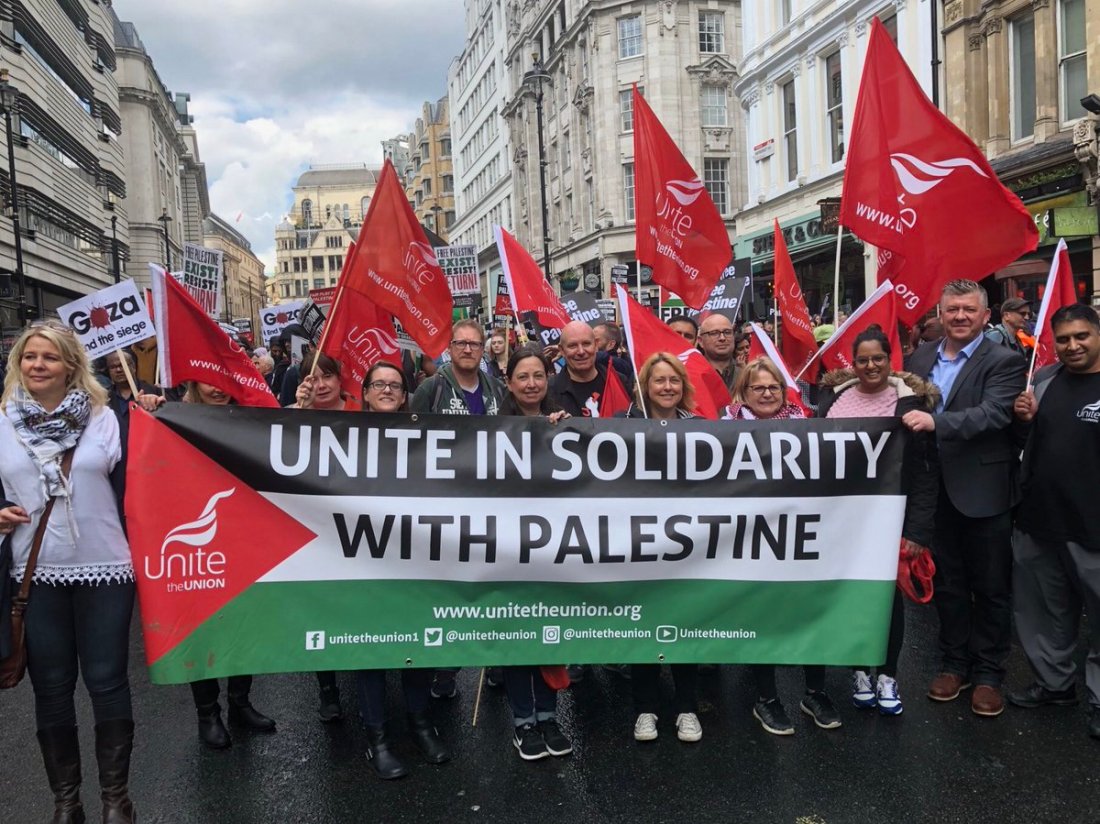

  • Hugh Lanning is an officer of Labour and Palestine, former Chair of the Palestine Solidarity Campaign and former Deputy General Secretary of the Public and Commercial Services Union.
  • You can follow Labour and Palestine on Facebook and Twitter/X.

Model motion for Labour Party conference 2024: Uphold international law for Palestinians

Featured

Model contemporary motion for Labour Party conference: Uphold international law for Palestinians

Conference notes:

  • On July 12, UN Secretary-General, António Guterres, said “Just when we thought it couldn’t get any worse in Gaza… civilians are being pushed into ever deeper circles of hell.”
  • On 19 July, the International Court of Justice ruled Israel to be unlawfully occupying Palestinian land in the West Bank, Gaza and East Jerusalem. It demanded Israel withdraws immediately, dismantles illegal settlements and pay reparations. It confirmed Israel is guilty of violating Article 3 of the International Convention on the Elimination of All Forms of Racial Discrimination, which prohibits racial segregation and apartheid. 
  • The ICJ’s January finding that South Africa’s claims concerning the right of Palestinians in Gaza to be protected from acts of genocide – and related prohibited acts identified in the Genocide Convention – are plausible.

Conference welcomes the decisions of the Labour government to restore UNRWA funding and abandon Tory attempts to block the International Criminal Court from holding Israeli leaders accountable for crimes against Palestinians.

Conference believes Britain has a moral and legal obligation not to assist violations of international law. We must commit to the application of international law, including abiding by rulings and judgements of the ICJ and ICC.

Conference believes the new Government should:

  • Support an immediate and permanent ceasefire.
  • Impose a full arms embargo until Israel complies with international law.
  • End trade with illegal settlements and all other trade that aids or assists Israel in maintaining its illegal occupation.

  • This motion is being circulated jointly by Labour & Palestine and the Palestine Solidarity Campaign.
  • Rules and deadlines for Contemporary Motions for 2024 can be found at https://labour.org.uk/annual-conference/information-for-delegates/ If you wish to submit a motion on behalf of your organisation please do this before 5pm, Thursday 12 September.

LABOUR MEMBERS FROM OVER 500 CLPs CALL ON STARMER TO BACK CEASEFIRE

Featured

By the Labour & Palestine Team

In a strong show of the growing pressure on Keir Starmer to back the call for a Ceasefire Now in Gaza, over 10,000 – including members of over 500 Constituency Labour Parties – have signed a petition reading “We call on the Labour Party leadership to join the growing international calls for an immediate ceasefire in Israel and Palestine.”

Commenting on the strength of support for the petition, Apsana Begum MP said, “The ongoing dehumanisation and collective punishment of Palestinians will be marked in history as a crime against humanity. It is vital that the Labour Party stand up against war crimes and be counted.”

Hugh Lanning of Labour & Palestine, who initiated the petition, said “That some 10,000 Labour members from over 500 CLPs have, signed the Labour & Palestine petition calling on the Labour leadership to back an immediate ceasefire confirms the strength of opinion at the party’s grassroots.”

He added, “Keir Starmer’s continuing refusal to make the call for a ceasefire and his threats to sack frontbench MPs who vote for one tonight is deeply shocking to members and out of step with the public, risking lasting damage to Labour support. It is time for him to listen and urgently change course.”

Welcoming the growing support for a ceasefire in the Labour Party, TSSA General Secretary Maryam Eslamdoust said “The Labour Party is supposed to stand on the side of the oppressed, and those backing the petition are doing just that. Instead, we have seen MPs being suspended or forced to resign shadow ministerial posts simply for supporting the cause of peace. It is not good enough.”

Young Labour Chair Nabeela Mowlana said, “The last few weeks have demonstrated the strength of feeling amongst the British public that we will not sit by as our political leaders allow atrocities to take place in Palestine. A ceasefire is the first step in a desperately needed peace process rooted in justice and liberation. The Labour leadership must do the right thing by supporting the vote for a ceasefire.”

And Mohammad Suhail, Young Labour International Officer, added “The overwhelming support this petition has received from across the Party is heartening and indicates the position members want to see Keir Starmer take. Ahead of any Commons vote on a ceasefire, we call on all Labour MPs to stand on the side of peace, and vote to call for a ceasefire.”

Long-standing Palestinian solidarity campaigner and Labour NEC member Jess Barnard said, “Keir Starmer is not just out of step with Labours membership, he is on another planet. 76% of the general public support a ceasefire, 10,000 members have now signed the Labour and Palestine petition, hundreds of councillors, regional and national labour figures have all supported the calls for an immediate ceasefire.”

Fellow NEC member Gemma Bolton joined those welcoming the strong support for the petition, saying “That over 10,000 Labour members have signed the petition shows that they, like the general public, overwhelmingly back a ceasefire. They rightly understand a ceasefire is the only way to stop the horrific scenes we have seen broadcast from Gaza – and commence the process of negotiating a just and lasting peace.”


STATEMENT: Labour Must Lead Demands for An Immediate Ceasefire

Featured

Labour & Palestine is horrified by the escalating violence in Israel and Palestine and the callous response of the UK government. We call on the Labour Party to act to help bring about an immediate ceasefire, as called for by the UN, the TUC and many others.

We are appalled by the loss of life of both Israelis and Palestinians and believe that the targeting and attacking of civilians and the imposition of collective punishments are, as is clear in international law, war crimes that must be condemned by all.

The UN Secretary General, Antonio Guterres, has said this latest outbreak of violence and slaughter of innocent civilians does not take place “in a vacuum”. The war in Gaza did not start on 7 October – it is a direct result of Israel’s illegal and brutal military occupation of Gaza, the West Bank and East Jerusalem since 1967.

The Israeli state has actively supported the building of illegal settlements in the West Bank, arrested and detained thousands – including hundreds of children – demolished homes and stood by while heavily armed illegal settlers viciously attacked Palestinians.

These breaches of Palestinian human rights have been well documented by the UN, Amnesty International, Human Rights Watch and the Israeli human rights organisation B’Tselem, among others. Yet these acts of violence, intimidation and oppression have been allowed to reach a new high since the extreme right-wing administration of Benjamin Netanyahu took office last year.

The failure of the parties to the Oslo Accords, including the UK, to fulfil the promises made to the Palestinian people of an independent state, have made any route to peace increasingly difficult.

The UK government’s uncritical support for Israel’s illegal actions is completely wrong.

The Labour Party must now lead demands for an immediate humanitarian ceasefire and the full application of international law to apply equally to all peoples.

Labour & Palestine.

Model motion – Oppose the Tory anti-boycott bill

Below is a model motion for CLPs to consider defending our right to boycott, which has been worked on by Labour & Palestine and Palestine Solidarity Campaign supporters who are active in the Labour Party.

It is important for CLPs to keep raising this issue to put pressure on in the run-up to further debates and votes in Parliament on the Tories’ anti-democratic legislation.

CLPs can still submit motions to this year’s Annual Conference – the deadline for motions is 5pm Thursday 21 September.

Alternatively, CLPs can instead pass the motion and send to the NEC (making the necessary small amendments to the model motion text.)

MOTION: Oppose the Tory anti-boycott bill

Conference shares the concerns of a wide range of civil society organisations – including the TUC, affiliated trade unions, charities, NGOs, faith, climate justice and human rights organisations – that the government’s ‘Economic Activity of Public Bodies (Overseas Matters) Bill’ or anti-boycott bill will limit the ability of public authorities to make ethical choices about spending and investment consistent with human rights, climate goals and international law.

We are proud of our movement’s historic support for boycott and divestment campaigns including the campaign to end apartheid in South Africa. Legal advice commissioned by the Labour Party makes clear that had this bill been law during the 1980s, it would have forced local authorities to do business with that criminal and racist regime.

The Tories have indicated that a major reason for proposing this law is to prevent public bodies from divesting from companies operating in Israel and occupied Palestine – even if they are complicit in violating international law and human rights.

Conference believes that public bodies and democratic institutions should be able to spend, invest and trade ethically in line with international law and human rights.

Any suggestion that, alone among peoples facing oppression around the world, Palestinians should be singled out and denied the right to appeal to people of conscience for support is wrong, runs counter to Britain’s legal obligations, and must be rejected.

Conference calls on the PLP to vote against the bill and, if it is passed, commits to repealing the anti-boycott law when Labour is in government.

LABOUR FRINGE: Building solidarity & speaking up for Palestine

Featured

Liverpool ACC, Monday October 9, 5.30pm.

RSVP here // Retweet here.

With: H.E. Ambassador Husam Zomlot // John McDonnell MP // Mick Whelan, ASLEF // Beth Winter MP // Simon Dubbins, Unite // Nabeela Mowlana, Young Labour // Hugh Lanning, Labour & Palestine // Jess Barnard, LP NEC // Louise Regan, Palestine Solidarity Campaign.

Labour & Palestine at Labour Party Conference 2023. Kindly supported by Unite the Union. Please note you need a Labour Conference pass to attend this event.

Palestine – what does a Labour ethical foreign policy look like?

Featured

By Hugh Lanning, Labour & Palestine

The election of Israel’s most right-wing Government ever under the resurrected Netanyahu makes yet more important the reaction of the international community. Is there ever going to be a tipping point when Western governments stand up to Israel’s pressure and say ‘enough is enough?’ Judging by the response of the British Labour Party in recent times, the prospects are not good.

Much lip-service is paid to an ethical foreign policy – dating back to Robin Cook’s honourable attempt at developing such an approach in the late 1990’s. So, what would an ethical Labour foreign policy look like? The cynical would say that the first challenge for Labour would be to have ethics and secondly a policy. In contrast, the Tories have both, namely the self-preservation of Western neo-liberal globalisation – or to put more simply – to look after the rich and their interests.

Palestine would not be the central or sole focus of an ethical foreign policy, but it should be both a priority and a litmus test. If a Labour ethical foreign policy can’t tackle or encompass Palestine, then it is not fit for purpose. Simply doing what the US, Israel, the City and the far-right want doesn’t work or pass any test by which Labour should behave, although you could easily think that is where the Party is taking its lead from.

A truly ethical foreign policy would have three pillars – ethics, decolonisation and non-violence. First, ethics – the basis should be to use international law as the ethical framework. It might be nice to contemplate alternatives, be it revolutionary or socialist, but as a first step international law is a low bar to which Labour should aspire to advocate.

In doing this Labour should take account of the nature and scale of the breach – not cherry-pick the popular or the easy. Nor will it be able to respond to every and any type of breach. But, using Israel as an example, its list of breaches is long, extensive and serious – the Occupation itself, the Wall, Settlements, the annexation of Jerusalem, its treatment of children and prisoners and the growing evidence of it being guilty of the crime of apartheid.

However, we should recognise that international law is a Western, orientalist construct – so how do you select how and where to act? A frequent question from supporters of Israel is ‘why Palestine?’ – why don’t you pick other countries?

Therefore, the second pillar of an ethical foreign policy should be De-colonisation – a principle to determine how and when to be pro-active and possibly intervene. Blair developed the concept of ‘humanitarian intervention’, which went from Kosovo, through Sierre Leone to Afghanistan, ending up in Iraq.

The problem with such a framework is that it is the West determining how, where and when to intervene. De-colonisation has been described as “deconstructing and dismantling neo-colonial ideologies regarding the superiority of Western approaches and working toward a redistribution of power that was accrued because of colonisation”. We should use decolonisation to determine whose side we are on and whose solution we support – is it positive or negative on that scale of the redistribution of power?

In addition, it is important to take into account what the British role has been and what the colonial legacy is. In the case of Palestine, we ruled it between the wars, gave it away from Balfour onwards, stood by whilst the Nakba took place and armed and financially supported Israel then and now. If we owe reparations to any country – Palestine is high up that list.

It should not be our solution, but to support outcomes wanted by the self-determined, indigenous groups – in this case by the Palestinians. Self-determination being pre-eminent, it could take many forms – aid, trade or maybe keeping away, not supporting its oppressors.

Blair’s doctrine was used as a justification for war, which leads to the third pillar of an ethical foreign policy – non-violent methods. Solutions should not be based on force and military interventions. South Africa showed what can be done – there are a wide range of options that can be used. In a globalised economy there are plenty of sanctions and economic levers that can be applied, as is called for under international law.

It is not for nothing that Israel is targeting and trying to demonise the international growing ‘boycott, divestment and sanctions’ campaigns – it is because they are potentially effective non-violent methods that could be used to bring about compliance with international law. BDS should be applied, not banned. We are a rich western country, that doesn’t mean we should aspire to be a global, military power spending billions of much-needed resources on what we euphemistically call ‘defence’.

In considering what is to be done, it is also important to consider what is doable, what is the UK role, and what are the priorities. But principles alone are not enough, it is not simply having the right policy. We need to build a mass movement within and without the Labour Party that would support a government taking a radical approach. We saw during Truss’s brief reign the powers that can be unleashed when the British establishment feels its interests are threatened.

Labour & Palestine is building and seeking to energise pro-Palestine support within the Labour Party. Our challenge is to both win support for a progressive ethical foreign policy and, then, to keep up the pressure to have it implemented. Palestine shows the problem is not a Labour Government being too radical, rather it is it walking away and ignoring the issue. The passing of resolutions at successive party conferences and in many CLPs has shown that the support is there within the Party. Over the coming months Palestinians are going to need support to combat the onslaught they are facing from a rampant colonial settler movement intent on stealing their land, heritage and freedom.


Eyewitness Palestine: For justice, for freedom & for the right of return – Louise Regan

Featured

Louise Regan reports on two recent solidarity delegations to Palestine.

In October and December 2022, I returned to Palestine, the first time since February 2020 due to Covid19. On both visits I was with other trade unionists, most who had not visited before and who were there to learn more about the situation, and to meet with individuals and organisations to deepen their understanding.

For Palestinians 2022 was the deadliest year since 2006. The monthly average of Palestinian fatalities increased by 57 per cent when compared with 2021. In the first half of October alone 15 Palestinians, including six children, were killed by Israeli forces during search-and-arrest operations, exchanges of fire, or in confrontations between Israeli forces and Palestinians in the West Bank including East Jerusalem.

In October we visited Nablus, a beautiful city in the West Bank. Nablus had been under curfew for several days and entry in and out was severely restricted. We have good links with the cultural centre in the camp and although there was clear evidence of clashes at the entrance to the town we made our way in with no problems. During our time in the camp it was clear that the situation was stressful for them.

As we left several armed vehicles arrived and we were questioned about the purpose of our visit. The following day four young Palestinians were killed in the camp – these were young people with hopes and dreams, young people who just wanted to enjoy their life but who are now gone forever.

Mural of murdered Palestinian journalist Shireen Abu Aqleh. Photo credit: Louise Regan

We also visited Aida Refugee camp in Bethlehem. Aida is the most tear gassed place on earth. The families there live under the eye of numerous military watchtowers and regular incursions in to the camp not only firing tear gas and skunk water but also arresting young people in the middle of the night. At the edge of the camp is the Lajee centre set up in April 2000, the centre is a sanctuary for the children and young people of the camp.

They have developed an outdoor play area, football pitch, a nursery and gym and they run music, dance and creative workshops. On the roof of the centre there is a garden area with a hydroponics greenhouse where they are growing and distributing fresh herbs and vegetables.

In December we met with representatives from Addameer and DCI Palestine. Two of the human rights organisations who have been categorised as terrorist groups by the Israeli state, a political decision with no evidence or justification being presented. Both organisations, along with four others, have had their offices raided and documentation and computers stolen.

DCI Palestine advocates for child prisoners. Most Palestinian children are arrested during the night in armed raids on their home. They are blindfolded, shackled and taken in military jeeps to detention centres where they face interrogation and torture. They are tried in military courts and regularly forced to sign confessions written in Hebrew, a language they do not speak. Their crime – throwing stones – a crime for which they can face up to ten years in prison or twenty years if they hit a vehicle. Addameer advocates for political prisoners who face administrative detention, a system put in place during the British mandate, where they can be detained without charge or trial for an indefinite amount of time.

I have visited Palestine many times and I am always in awe of the people, their sumud ‘steadfastness’ and their resilience against the oppressive regime under which they live. The ongoing occupation, the human rights abuses they face on a daily basis limiting their ability to work, to access their own lands and family, to attend medical appointments or even go to school are all truly shocking and something that once you have seen you cannot un-see.

On the 2nd November 1917 British Foreign Secretary Arthur Balfour issued the Balfour Declaration which stated:

‘His Majesty’s Government view with favour the establishment in Palestine of a national home for the Jewish people, and will use their best endeavours to facilitate the achievement of this object, it being clearly understood that nothing shall be done which may prejudice the civil and religious rights of existing non-Jewish communities in Palestine, or the rights and political status enjoyed by Jews in any other country.’

These 67 words written over one hundred years ago led to not only the mass expulsion of the Palestinian people from their homes and land but also the ongoing occupation, control and intimidation of the Palestinian people until this day.

During the last year important reports by B’Tselem, Human Rights Watch and Amnesty have all been released calling Israel an apartheid state. During all my visits I have witnessed apartheid in action – from the restriction of Palestinians freedom of movement, the segregation and control of their daily lives to the dispossession of land and property.

Roadside checkpoint sign in Palestine. Photo credit Louise Regan

On one of my first visits to Palestine I was told that Palestine was being built out of existence. What I witnessed in October and December – the huge settlement expansion, the new settler only roads cutting through the Palestinians land and the escalating house demolitions and evictions means that the reality of this statement is coming ever nearer. 

In Sheikh Jarrah when one of our union members cried after hearing about the plight of the families there – the Palestinian father we were meeting with said “we thank you for your tears but we don’t need tears – we need voices – go back and tell people what you have seen – tell them our story as we are voiceless.”

Let us all be the voice of the Palestinians, let us all speak out until we get justice and freedom for the Palestinian people.


  • You can follow Louse Regan on twitter here.
  • Join the Palestine Solidarity campaign here; and follow them on FacebookTwitter and Instagram.
  • This piece was originally published on Labour Outlook here.