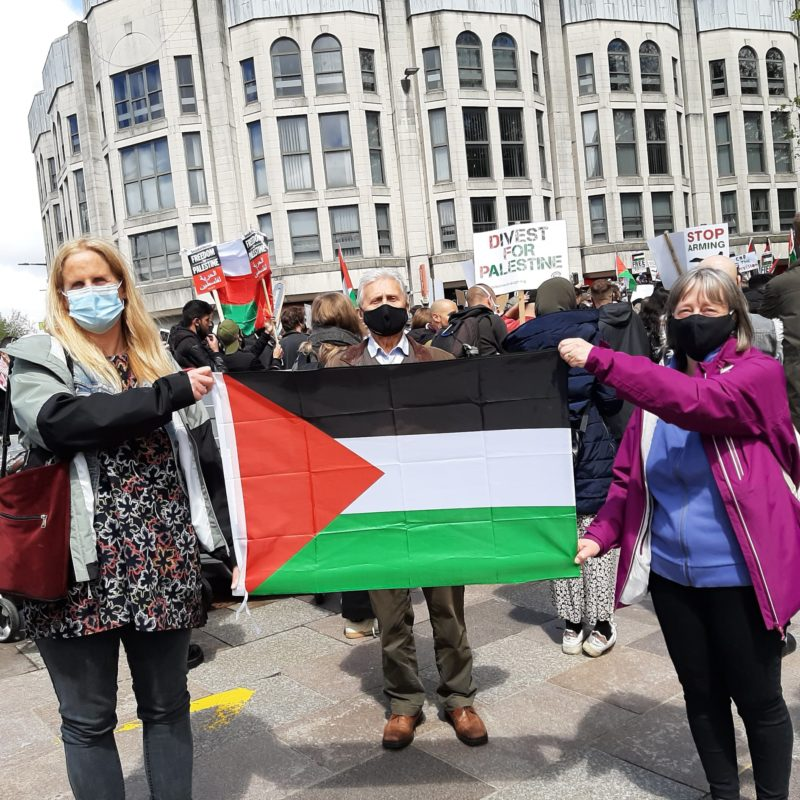
Why Labour Women Speak Up For Palestine – Kim Johnson MP

Thank you to Labour & Palestine for inviting me to speak today.

As others have been right to recognise – the terrain on the international stage has shifted massively.

Russia’s invasion of Ukraine has sparked outpourings of solidarity – in action and feeling – for refugees fleeing violence in their homes, for the assault on territorial sovereignty, and in unconditional support of those fighting to defend their communities and their country.

The scenes we have all witnessed in Ukraine over the past days have most certainly been heart breaking, and we must do everything in our power to bring about a diplomatic solution to this dangerous crisis based on peace, security and human rights – including opening our doors to refugees fleeing the war.

While such expressions of solidarity – especially alongside calls for peace – are without a doubt sincere and welcome, and I have added my own voice multiple times in the chamber and elsewhere, those of us who have championed the cause of the Palestinians, the Yemeni’s, the Kashmiri’s, the Kurds and so many others must now take up the struggle to ensure that these principles are applied unanimously, equally and without discrimination.

While White refugees are being prioritised at the borders, Black residents in Ukraine are left stranded, pushed to the bottom of lists and forced to wait in unendurable cold and fear while others are allowed to pass on ahead. While Black refugees and asylum seekers from Asia and Africa are dying in the English Channel, threatened with having their boats pushed back to sea, Ukrainian refugees are being offered free and safe passage underneath them on the Eurostar.

Where language such as ‘heroic resistance,’ ‘illegal occupation,’ ‘upholding sovereignty and international law,’ and welcoming refugees have been thrown around freely by politicians and news pundits in relation to this conflict, these expressions have been sorely missing when referring to the occupation in Palestine, and in solidarity with Palestinians resisting the expansion of illegal settlements, apartheid and oppression.

All refugees have the right to sanctuary and the right to return home. All peoples have the right to resist oppression, and to live in dignity and freedom. Today, we must take the spotlight shone on these principles by the Ukrainian struggle and make sure it shines strongly on the rest of the world.

Making these comparisons is not to engage in “whataboutery,” or to pit refugees already in desperate need against each other. It is in fact the opposite. We must all work to make this terrible moment a turning point, one which forever changes our treatment of resistance movements and refugees.

Palestine is one of the clearest examples where such language and condemnation is too often avoided on the international stage, including here in the UK.

The recent reports by B’Tselem, Human Rights Watch and Amnesty echo what Palestinian civil society has been saying for decades – a system of apartheid is being implemented across the entirety of historic Palestine – from the Jordan River to the Mediterranean Sea.

These past couple of years have formed a turning point for the Palestinian struggle. After Trump’s ‘Deal of the Century’ gave the green light for unhindered Israeli expansion of illegal settlements, we have seen an escalation of the systematic expulsion of Palestinians from their homes and the collective punishment of Palestinians living inside the occupied territories.

As vice chair of the All-Party Parliamentary Group on Palestine, I’ve heard staggering testimonies from Palestinians living in Gaza, the West Bank, refugee camps and the diaspora.

We’ve heard from human rights groups talking about the distinct two-tier legal systems that push Palestinian children in the West Bank into military court. In the last 20 years, an estimated ten thousand Palestinian children have been held in the Israeli military detention system. That’s about 500 – 700 every single year – these are the only children in the world who are systematically prosecuted in military courts. They consistently lack fair trial rights, particularly by juvenile justice standards.

We know about the annexation of Palestinian lands, the eviction and dispossession of Palestinian families in East Jerusalem and Sheikh Jarrah and so many other places – a modern day Nakba unfolding right in front of us. In Liverpool – as in many cities across the country – it was incredible to see a new generation take to the streets spontaneously in solidarity with the residents of Sheikh Jarrah resisting the illegal seizure of their homes, this is what solidarity is all about, people see what’s going on in Palestine and will not stand for it.

As women speaking up for Palestine, and just after celebrating international women’s day, it is important we recognise and pay tribute to the resilience and steadfastness of Palestinian women and the leading role they play in the struggle against Israel’s widespread and systematic human rights violations.

Since the start of the Israeli occupation in 1967, more than 10,000 Palestinian women have been arrested and detained in the West Bank alone by the occupation forces. A total of 31 Palestinian women are currently being held in the Israeli prison system, which permits authorities to detain Palestinians with no charge or trial – with no time limit. From resisting the occupation and home demolitions, to organising political activities, to working and supporting their families – Palestinian women lead the struggle for dignity and freedom and resist the challenges of gender-based oppression as well as the Israeli occupation.

So to sum up – I am really proud to be at this event tonight in solidarity and support with the Palestinian people, I’m proud to be on the panel with these great speakers, I’m proud to be a trade unionist with a long history of internationalism,  but more importantly I’m a proud Scouser – proud of our history of solidarity with international freedom struggles. We stood shoulder to shoulder with our South African brothers and sisters fighting the brutal system of racial segregation and white supremacy. We took bold action despite huge pressure – the council boycotted South African goods, dock workers refused to handle imports from South Africa, food workers refused to handle South African goods, Ford Car workers packed anti-Apartheid leaflets into cars shipped to South Africa, university students held sit ins and charities and local coalitions took direct action.

We have so much to learn from this history of solidarity – not least that systems of oppression can and will fall. There is power in solidarity.

These actions taken by trade unions, students and our communities brought down that vicious regime and this is what we all need to do now for Palestine.

  • This is the text of a speech given by Kim Johnson MP to the recent Labour Women Speak up for Palestine event hosted by Labour & Palestine.

Women Speak up for Palestine – Beth Winter MP

Beth Winter MP

Thank you for inviting me to address this evening’s event.

It is a privilege to be on the same panel as Samia al-Botmeh, our sister who teaches at Birzeit University.

And I’m delighted to join my colleague Kim Johnson MP, our trade union colleagues, and from Palestine Solidarity Campaign.

It is very welcome that Labour and Palestine have organised this fringe, and are active organising in the Labour Party.

Because while our eyes and our minds have been occupied  very much – and rightly so – by both Covid 19 and, now, by the terrible war in Ukraine, the harshness of life for the vast majority of the people of Palestine has not changed – indeed, for many, it will have grown harder and harsher.

I’m Welsh from the top of my head to the soles of my feet, but those feet learnt at an early age how important it was to walk in the shoes of my fellow human beings because we grow stronger as individuals and as a nation when we care about others, and act against injustice wherever we find it.

So sometimes I imagine myself as a Palestine woman, having to pass all those road blocks to get to work, worrying about my children being safe when they go to school past Israeli forces brandishing their guns. Worrying about the possibility that my home could be demolished next week by outside forces.

What if this woman (who is so much like me) needs hospital treatment. What if she is pregnant and the time limit on her permit to travel runs out when she is in labour? Will she be forced to give birth at a checkpoint?  What if this was how we had to live in the UK?


Israel and Palestine are two states sitting side by side, with one consuming the other.

One is a major power financed by the West. The other remains impoverished, and unrecognised as a state by the West.

Israel’s wealth means it has a GDP per person of $43,000 a year- similar to the UK – whilst Palestine’s is estimated at less than $6000 per year. These figures come from the IMF.

Israeli military spending per person is second only to the US.

The Palestinians remain under militarised occupation in the West Bank, under military siege in Gaza and with millions still living in refugee camps. Israeli settlers and the Israeli government continue to seize more and more land in the West Bank, whilst life is squeezed in Gaza by the blockade.

Last Summer we saw further escalation of violence with the seizure and demolition of houses in the Sheikh Jarrah area of East Jerusalem, with the families expelled. This action continues, and which – given it is in occupied territory –  the UN has said ‘may amount to war crimes’.

This action inevitably created conflict, and we saw over 200 deaths in Gaza, and the shocking Israeli attack on the Hanadi Tower housing Al Jazeera and other media outlets, in Gaza City.

So despite everything else, we cannot forget the Palestinians and the misery they are forced to live in by the Israeli government.

Fortunately we are active here in the UK.

I have long been a supporter of PSC and of MAP. And PSC has continued to grow, through its own active membership, and also building on its relations within the trade union movement. 

That growing strength of opinion in support of Palestine  was shown at Labour’s annual conference last year, so it is worth reflecting on the policy passed  by that conference last September, thanks in no small part to the work of Labour and Palestine, working closely with PSC.

That policy was clear, and in it, the Conference resolved the party’s priorities are to,

“ensure that Israel stops the building of settlements, reverses any annexation, ends the occupation of the West Bank, the blockade of Gaza, brings down the Wall and respects the right of Palestinian people, as enshrined in international law, to return to their homes.“

And in terms of how we do that, the policy included,

‘to support “effective measures” including sanctions, as called for by Palestinian civil society, against actions by the Israeli government that are illegal according to international law’.

This was a significant  development giving a policy anchor for Labour MPs and Labour activists to point to when we are campaigning to support the Palestinians.

And alongside that we have also seen a hardening amongst mainstream civil society and human rights organisations against Israel’s actions.

In 2020, the TUC called settlement building a ‘significant step’ towards the UN Crime of Apartheid.

In 2021, both Human Rights Watch, and also B’Tselem, the Israeli human rights organisation, concluded unequivocally that Israel is practising the crime of apartheid as defined by the UN.

And in recent weeks, at the start of February, Amnesty International published it’s report, Israel’s Apartheid against Palestinians: Cruel System of Domination and Crime against Humanity.

Amnesty is the world’s leading human rights organisation, and their views carry significant weight. Their report creates additional pressure on the international community to act on Israel’s violations of human rights.

But our opponents are organising as well.

There is hostility to our solidarity, and to the measures we use to express that.

We must be prepared counter them..

So what do we do now?

Well – We continue to call for an end to the Israeli occupation.

We call on all political and trade union organisations and public representatives across the UK to make it clear to the Israeli Government that its annexation of the West Bank and the siege of Gaza will have consequences.

I mentioned B’Tselem earlier. We must support the Israeli anti-occupation movement.

We must support economic sanctions and an end to the sale of arms to Israel.

We must ban the import of goods from the illegal settlements.

We must recognise the State of Palestine and work for a two-state peaceful solution to this on-going and oh so damaging situation.

And we, as women activists, need to forge closer links with Palestinian women. And I hope Samia and PSC can help us with that.

Samia, there is an olive tree in Palestine , a gift from me one Christmas – one day I will sit by that olive tree with my Palestinian and Israeli friends in peace and friendship.

  • This is the text of a speech given by Beth Winter MP to the recent Labour Women Speak up for Palestine event hosted by Labour & Palestine.

Labour Women Speak Up for Palestine

On Monday March 14 2022, only days after International Women’s Day and in advance of Labour Women’s Conference, hundreds joined Labour and Palestine’s online ‘Labour women speak up for Palestine’ rally.

The event, chaired by the Labour peer, former NUT General Secretary, and long-time advocate for Palestinian human rights, Christine Blower, heard from figures across the Labour and trade union movement in addition to a live link directly from Palestine, with Samia Al-Botmeh, a Palestinian academic at Birzeit University.

Blower began the meeting by highlighting the continued need to support the Palestinian cause because ‘news attention on Palestine waxes and wanes but the struggles of Palestinian women for their human rights and liberation cannot, does not and will not’. She then introduced the first speaker, the MP for Cynon Valley, Beth Winter.

Winter began by asking listeners to put themselves in the shoes of Palestinian women and highlighting the effect of occupation on their day-to-day access to public services and healthcare. She said that ‘we cannot forget the Palestinians and the misery they’re forced to live in by the Israeli Government’ and pointed to the effects of occupation on the Palestinian economy – while Israel enjoyed a similar GDP per capita to the UK.

Clare Baker, from Unite the Union, restated her union’s long history of solidarity with Palestine and spoke about the importance of the Palestine motion passed at Labour’s conference last year. The motion calls for sanctions and notes that Human Rights Watch and B’Tselem – now joined in this by Amnesty International – says that Israel is practising apartheid.

The next speaker, Philipa Harvey, spoke about her experience as a TUC delegate to Palestine and the effect of the occupation on health, education and trade unionism, and how Palestinian women were leading the resistance in all these areas. She concluded her contribution by emphasising that ‘we speak up for Palestinian women because they’re resisting in all aspects of life.’

Gemma Bolton said that ‘Palestinians are treated like second class citizens and sometimes not like citizens at all’ and stressed that the voices of Palestinian people are often written-out of the debate. She insisted on the need to continue the fight in the Labour Party to ensure Palestinian voices are heard and urged the audience to invite speakers on Palestine to their CLP or Labour branch meeting.

The next speaker, Kim Johnson, MP for Liverpool Riverside, highlighted the differences between the response to the situation in Ukraine and the occupation and siege in the West Bank and Gaza. She said that while pundits have rightly used expressions like ‘violating international law’ and ‘illegal occupation’ in the case of Ukraine, ‘these expressions and comments have been sorely missing when referring to the occupation in Palestine’.

She commented further that we should apply our values consistently, and that ‘all people have the right to resist oppression and live in dignity and freedom’.

Christina McAnea, General Secretary of Unison, sent a statement of support to the rally which emphasised the situation of women in the occupied territories and Gaza. She said ‘the lack of freedom of movement and other fundamental rights, resources, markets and means of production, has decimated the Palestinian economy, driving millions of women into poverty and denying them the right to decent work and quality public services’.

Next, listeners heard from the Palestinian academic, Samia Al-Botmeh, directly from Palestine. Highlighting the importance of international solidarity, she said ‘I ask for your solidarity on behalf of my people and Palestinian women who have to bear the brunt of these measures. Your solidarity keeps our resistance going and enables us to expose these policies and generate measures to resist the occupation’.

She continued: ‘it’s extremely important to expose these violations… because the extent to which Israel is implementing its colonial policies is mocking the world. I ask for your solidarity on behalf of my people and Palestinian women who have to bear the brunt of these measures. Your solidarity keeps our resistance going and enables us to expose these policies and generate measures to resist the occupation’.

Next, Louise Regan, speaking on behalf of the NEU, recounted some of her own experiences of trade union delegations to Palestine – including watching teachers resist the closure of their school by Israeli military, and the use of tear gas by soldiers in schools. She emphasised the psychological ‘impact of going home at night and not knowing if it’s a safe place for your children’.

The final speaker was Rivkah Barnard of the Palestine Solidarity Campaign. She said that ‘we should never forget that Palestinians aren’t passive victims; they are leading the struggle’, and that ‘the Palestinian resistance to occupation remains strong and shows amazing grassroots power.’

She continued: ‘part of our role in the solidarity movement is to create the space for Palestinians to be heard – but we also need to take forward the demands that emerge’.

That means stopping UK complicity in Palestinian oppression – suspending arms sales to Israel, ending trade with illegal Israeli settlements, and resisting the Government’s legislative proposals to criminalise Boycott, Divestment and Sanctions.

‘If passed, this legislation will choke our ability to take action and hold companies to account – whether its arms companies selling weapons to Israel, or companies that make bulldozers to demolish Palestinian homes.’

In her closing words to the rally, Christine Blower urged everyone to continue the fight for Palestinians human rights in the Labour Party. She concluded: ‘no one will be free until we are all free’.

Solidarity with Sheikh Jarrah – Tony Burke speech at London protest

“Under the cover of darkness and the freezing cold the Israeli state violently attacked the home of the Sal-hee-yafamily.

• They beat the family,
• they arrested the family
• and they destroyed their home of over 60 years.

There cannot be any argument that this was not the actions of a violent apartheid state ethnically cleansing East Jerusalem.

15 people are now homeless, and join the thousands of Palestinians ethnically cleansed by Israel to make way for their illegal settlers.

The cruelty of this act…. the cowardice of it, shows the world just how barbaric Israel is – Yet the world stands by and watches. Our governments only urge caution to Israel, and by doing nothing the Israeli state is given a green light to continue their suppression, repression, ethnic cleansing and implementation of apartheid against the Palestinians,

And it is quite outrageous when we witness the mass destruction of Gaza at the hands of Israeli military, the ethnic cleansing of Sheikh Jarrah, and this most recent cruel act against the Sal-hee-ya family, to suggest that this a war of two equal parties.

The resistance of the Palestinians is in no way comparable to the massive military might of Israel;

• It is Israel that has occupied Palestinian lands for the last 54 years.

• It is Israel that has moved nearly 700 000 illegal settlers into the West Bank.

• It is Israel that is been actively ethnically cleansing Palestinians from their homes and lands.

• it is Israel that has inhumanely blockaded Gaza for the last 14 years.

• and it is Israel that has become a state guilty of building and implementing a system of apartheid against the Palestinians!!

Let us never forget thought that with international boycott actions we helped bring down apartheid in South Africa and ensured that Nelson Mandela became president.

We can do this again.

We must stand with people like the Sal-hee-ya family who are attacked and oppressed by states wherever it occurs in the world, in Colombia, in Turkey, in Western Sahara and in Palestine.

We must too fight against our governments supporting the regimes that inflict oppression, ethnic cleansing, violence and apartheid.

We must fight back against our own government’s plans designed to oppress our solidarity;

  • we must oppose the police and crime bill and
  • we must oppose the anti BDS law.

The Palestinians have been abysmally treated for decades and decades, that needs to change

We demand an end to the barbaric actions of the Israeli state.

For too long the international community has stood idly by as the Israeli state has been allowed to carry out its crimes and this cannot be tolerated or accepted any longer.

So I say this – even though it is difficult, and there are forces against us –

  • we can end Israeli apartheid!
  • solidarity with the Sal-hee-yafamily!

Solidarity with Sheikh Jarrah!

Free Palestine!”

Add your name – Labour must speak up for Palestine!

Add your name here

“As an internationalist and democratic socialist party, it is the responsibility of the Labour Party to speak up for Palestine and stand in solidarity with the Palestinian people and their fundamental rights, including to self-determination.

Earlier this year, the international community and labour movement widely condemned Israel’s militarised violence against the Palestinian people, including the attacking of the Al Aqsa mosque, the forced displacements from Sheikh Jarrah and the deadly assault on Gaza.

The seriousness of the situation facing the people of Palestine is confirmed by the fact the International Criminal Court is holding an inquiry into abuses committed in the occupied Palestinian Territories since 2014.

The continuing de facto annexation of Palestinian land by accelerated settlement building alongside statements of Israel’s continuing intention to proceed with annexation, show it is clearer than ever that the Israeli State is intent on eliminating any prospects of Palestinian self-determination.

Major reports by Human Rights Watch and the Israeli human rights group B’Tselem have added weight to the TUC’s warning that Israel taking these steps would represent ‘another significant step’ towards the UN Crime of Apartheid and strengthen the Palestinian call for the ICC to investigate.

Labour must build on – not step back from – its commitments to immediate recognition of the state of Palestine and an end to the blockade, occupation and settlements as outlined in the 2017 and 2019 manifestos, and in the motions passed by the Party’s annual conferences in 2018 and 2019.

We must support “effective measures” including sanctions, as called for by Palestinian civil society, against actions by the Israeli state that are illegal according to international law. This must include action to ensure that Israel stops the building of settlements, reverses any annexation, ends the occupation of the West Bank, ceases the blockade of Gaza, brings down the Wall and respects the right of refugees to return to their homes under international law.”

Add your name here

Since our foundation, Labour & Palestine has campaigned on the basis of the need for an ethical foreign policy for Labour, which must have securing freedom, justice and equality for the people of Palestine as a priority. This must be done within an anti-racist framework based on the principles of equality, human rights and international law.

In particular, an ethical foreign policy for Labour must recognise that there can be no end to the oppression of Palestinian people whilst there is a continuation of the occupation of East Jerusalem, Gaza and the West Bank, the denial of full equality to all Palestinians – including those who are citizens of Israel and a failure to recognise the rights of Palestinian refugees.

Concretely, action is needed now due to Israel’s continuing illegal actions and Labour should adhere to an ethical policy on all UK trade with Israel, including stopping any arms trade used to violate Palestinian human rights. A policy on Palestine driven by support for human rights and international law means applying these principles to UK trade with Israel, including applying international law fully to the settlements and any trade agreements.

Now is the time for Labour to step up to its duty is to support the oppressed challenging the discrimination they face, backing a just solution for the people of Palestine based on self-determination for Palestine and equality and human rights for all. For this reason Labour & Palestine is circulating the new statement above – please add your name!

  • Labour & Palestine is supported by Aslef, BFAWU, CWU, NUM, TSSA, Unison and Unite.

Justice for Palestine – New Model Motion for CLPs

In addition to our model motion for Labour Party Conference 2021, please find below our new model motion for general discussions in Labour Party meetings in solidarity with Palestine.

This CLP notes:

  • The international community and international labour movement widely condemned the state of Israel’s latest militarised violence against the Palestinian people, including the attacking of the Al Aqsa mosque, the forced displacements from Sheikh Jarrah and the deadly assault on Gaza.
  • The International Criminal Court’s decision to hold an inquiry into abuses committed in the occupied Palestinian Territories since 2014.
  • The recent report by Human Rights Watch – ‘A Threshold Crossed’ – details how Palestinians are ‘born unequal’, shown recently by the discriminatory approach excluding Palestinians from Israel’s vaccination programme.
  • Clear policy passed at Labour Party Annual Conferences 2018 and 2019 in solidarity with the Palestinian people and against Israel’s ongoing illegal occupation.

This CLP believes:

  • The aggression earlier this year, together with the de facto annexation of Palestinian land by accelerated settlement building and statements of the Israeli state’s intention to proceed with annexation, show it is ever clearer that the Israeli State is intent on eliminating any prospects of Palestinian self-determination.
  • The aforementioned Human Rights Watch report and a further recent report from the Israeli human rights group B’Tselem have added weight to the TUC’s warning that the ongoing Israeli Government’s illegal settlement building and annexation would represent ‘another significant step’ towards the UN Crime of Apartheid.

This CLP resolves:

  • To stand in solidarity with the Palestinian people and their fundamental rights, including the right to self-determination.
  • That action is needed now due to the Israeli state’s continuing illegal actions and that Labour should adhere to an ethical policy on all UK trade with Israel, including stopping any arms trade used to violate Palestinian human rights.
  • To support “effective measures” including sanctions, as called for by Palestinian civil society, against actions by the Israeli state that are illegal according to international law; in particular to ensure that the state of Israel stops the building of settlements, reverses any annexation, ends the occupation of the West Bank, the blockade of Gaza, brings down the Wall and respects the right of refugees to return to their homes under international law.

Labour Fringe 2021 : Speaking Up For Palestine – A Litmus Test for Labour

Labour & Palestine is pleased to announce details of our fringe meeting at Labour Conference 2021 – kindly hosted by Unite the Union.

Date & Time: Tuesday September 28, 5.30pm.

With: H.E Husam Zomlot, Palestinian Ambassador // Karma Nabulsi, Palestinian Writer & Activist // John McDonnell MP // Kim Johnson MP, Vice-Chair, APPG on Palestine // Bell Ribeiro-Addy MP // Mick Whelan, ASLEF General Secretary & Unions for Labour Chair // Louise Regan, Palestine Solidarity Campaign & National Education Union // Tony Burke, Unite AGS // Gemma Bolton, Labour NEC member // Hugh Lanning, Labour & Palestine // Chair: Simon Dubbins, Labour & Palestine + Unite Director of International.

  • RSVP, share & invite friends on Facebook here.

Labour & Palestine – Motion for Labour Conference 2021

Please consider putting our model motion for Labour Conference 2021 to your Constituency Labour Party. The full text of the current version of the motion is below – we may well send out updated versions as the situation develops, but we have been asked by a number of people to send out the below asap, so are currently circulating the below.

The deadline for submitting motions to Conference is September 13, but some CLPs will be discussing their motion very soon, so be sure to find out your local schedule on this. Furthermore, if your CLP is not yet discussing Conference motions, it can also easily be the basis of a general motion on Palestine to your ward or CLP.

“Conference condemns Israel’s militarised violence attacking the Al Aqsa mosque, the forced displacements from Sheikh Jarrah and the deadly assault on Gaza.

Together with the de facto annexation of Palestinian land by accelerated settlement building and statements of Israel’s intention to proceed with annexation, it is ever clearer that Israel is intent on eliminating any prospects of Palestinian self-determination.

Conference notes the TUC 2020 Congress motion describing such settlement building and annexation as ‘another significant step’ towards the UN Crime of Apartheid; reinforced by the recent reports by B’Tselem and the Human Rights Watch, whose report – ‘A Threshold Crossed’, details how Palestinians are ‘born unequal’, shown recently by the discriminatory approach excluding Palestinians from Israel’s vaccination programme.

Conference welcomes the International Criminal Court decision to hold an inquiry into abuses committed in the occupied Palestinian Territories since 2014.

Conference resolves that action is needed now due to Israel’s continuing illegal actions and that Labour should adhere to an ethical policy on all UK trade with Israel, including stopping any arms trade used to violate Palestinian human rights.

Conference resolves to support “effective measures” including sanctions, as called for by Palestinian civil society, against actions by the Israeli government that are illegal according to international law; in particular to ensure that Israel stops the building of settlements, reverses any annexation, ends the occupation of the West Bank, the blockade of Gaza, brings down the Wall and respects the right of refugees to return to their homes under international law.”

Save Sheikh Jarrah – labour movement voices speak out

We reproduce below a statement signed by ourselves, the Palestine Solidarity Campaign, unions and other civil society organisations that calls on British Government to take action over Israel’s ethnic cleansing of neighbourhoods in occupied East Jerusalem.

The statement calls on British Government, public bodies and civil society to recognise the laws of Israel to be inherently discriminatory.


Full Statement: Stop the ethnic cleansing of Jerusalem. Save Sheikh Jarrah.

We, the undersigned, are deeply concerned by Israel’s ongoing ethnic cleansing of neighbourhoods in occupied East Jerusalem. The use of illegal and quasi legal means to evict Palestinian families from their homes, in order to replace them with Jewish settlers, is a clear example of demographic manipulation and ethnic cleansing.

Over 1,500 Palestinians from neighbourhoods in Jerusalem are facing the threat of forced displacement and home demolitions by Israeli authorities. Children make up a large percentage of the families threatened with homelessness.

The neighbourhood of Sheikh Jarrah is just one of those affected. In 1956, Jordan made an agreement with the UNRWA to build houses in Sheikh Jarrah for 28 families who had been dispossessed of their homes in various parts of historic Palestine by Israel. Those families gave up their refugee rations cards on the understanding that the new homes would be given to them and registered in their names.

In 1967, Israel illegally annexed all of East Jerusalem, including Sheikh Jarrah, and shortly afterwards passed the Legal and Administrative Matters Law. Like the Absentees’ Property Law, this facilitates the transfer of property from Palestinians to Jewish Israelis through quasi legal means.

Backed by the state and its discriminatory laws, settler groups have claimed ownership of the land in Sheikh Jarrah and implemented a creeping takeover of Palestinian homes, aided and abetted by Israeli courts and the security forces. Three families, totalling 67 people, were forcibly evicted from Sheikh Jarrah in 2009. The Israeli District Court recently ordered four more families to leave their homes or face eviction in the coming days. Once evicted, those families face additional legal costs and the prospect of having their Jerusalem residency rights revoked.

We call on the British Government, public bodies, and civil society, to hold Israel accountable and take meaningful action to prevent the further ethnic cleansing of Palestinians from Jerusalem. This includes recognising the laws of Israel to be inherently discriminatory and used to maintain Jewish Israeli dominance over Palestinians.

Signed by:

  1. Unite the Union
  2. National Union of Rail, Maritime and Transport Workers (RMT)
  3. GMB Union
  4. National Education Union (NEU)
  5. Bakers, Food and Allied Workers’ Union (BFAWU)
  6. Public and Commercial Services Union (PCS)
  7. Palestine Solidarity Campaign (PSC)
  8. War on Want
  9. Friends of Al Aqsa
  10. Amos Trust
  11. Sabeel-Kairos
  12. Labour & Palestine
  13. Arab Labour Group
  14. Israeli Committee Against House Demolitions UK (ICAHD)
  15. Jews For Justice For Palestinians (JFJFP)
  16. Stop the War Coalition
  17. British Committee for Universities of Palestine (BRICUP)

Palestine – Labour should loudly put pressure on Biden

Biden taking over from Trump as US president gives us an opportunity to speak up for Palestinians and ensure Israel complies with international law, writes Hugh Lanning of Labour & Palestine.

Among the many people around the world who will watch eagerly to see if incoming President Joe Biden has a different approach to foreign policy from his reactionary and regressive predecessor will be those from Palestine.

Under President Donald Trump, we saw an immediate hostility to the cause of justice for Palestine and full support for the policies and actions of the government of Israel.

This was best exemplified by Trump’s decision to move the US embassy from Tel Aviv to Jerusalem.

This was a highly significant move supporting Israel’s ambition to have Jerusalem as its capital, even though Tel Aviv is Israel’s globally recognised capital.

Additionally, funding for the UN’s Relief and Works Agency (UNRWA), which aids Palestinian refugees, was slashed.

Then we saw the formulation and announcement of his so-called “Deal of the Century,” which provided cover and justification for Israel’s subsequent proposals for large-scale new annexations of Palestinian land in the West Bank.

This one-sided plan was definitely not a “deal.” Rejected by all the Palestinian leadership groups, it seeks to formalise and recognise internationally for the first time Israel’s wished-for borders — based on occupation, annexation and settlements — all illegal under international law.

Its implementation through annexation would leave the disconnected centres of Palestinian population completely encircled and separated and destroy any prospect of a viable, independent Palestinian state.

Such an annexation would not only consolidate the theft of Palestinian land but the intention is still for Israel to maintain military and security control of the whole area, controlling the borders, air and trade.

But these threats will not go away with the departure of Trump.

He might be going, but the plan remains. In reality it was the Israeli government’s agenda that Trump was endorsing, with his plans only differing from Benjamin Netanyahu’s at the margins.

Furthermore, despite Israel’s agreements with the UAE, Bahrain and others — a promise to set aside annexation — the government has made it clear that it will proceed with annexation at some point.

Israel’s continuing and ever rapidly growing illegal settlement expansion programme — another form of “land grab,” stealing land and resources which it has no rights to — tells us that it will indeed proceed.

In an interview since the US election, vice-president-elect Kamala Harris — not historically a friend of Palestine — said the new administration would want to restore relations with Palestine, restore the refugee funding to UNRWA and still, in theory, try to seek a two-state solution.

She went on to say that a Biden administration would oppose annexation and settlement expansion, but no mention was made of moving the US embassy or how a two-state solution might be achieved.

This is a modest but welcome improvement, but opposing the settlements, ending the occupation and the siege of Gaza has been the stated policy — excluding Trump — of Western governments for decades.

Yet the reality is that with each passing decade, Israel has been making any solution but an Israel dominant and a subjugated Palestine less and less possible to achieve.

Now, post-Trump, we must seize the opportunity to proactively raise the issue of Palestine and not be on the defensive.

Our approach must be focused on the key issues of equality, international law and human rights — the issues are very clear and straightforward — and show without doubt that when it comes to Palestine there is an oppressor and the oppressed, namely Israel as an occupier and the Palestinians the occupied.

We must also continue to do what Palestinians ask and both tell their story and enable spaces where Palestinians can tell their story.

They believe if people know the facts the injustice will be recognised and eventually be put right.

Palestinians have not and will not be going anywhere and, in the long-term, it is not tenable for Israel to keep millions of them captive.

This must also be the approach of the Labour Party — in line with the strong motions in support of Palestine passed at its 2018 and 2019 conferences — which should be putting clear pressure on Boris Johnson’s government to strongly oppose the ongoing threat of illegal annexation and the expansion of the settlements programme.

Vital to this is keeping the issue of sanctions on the agenda in line with the Palestinian call this year for “effective measures” to be taken in order to get Israel to comply with international law.

We saw with apartheid in South Africa, despite years of consumer boycotts and divestments campaigns, it was only when governments acted and introduced or threatened sanctions that the final progress was made to ending apartheid.

Historically, Israel has only gone to the negotiating table when under pressure from the US, in particular the questioning of its funding arrangements supporting Israel’s military forces and their occupation of Palestine.

In a welcome first step earlier this year, Lisa Nandy said that the Labour Party would support a ban on settlement goods if annexation goes ahead.

It was the first time the Labour Party has officially committed itself to government action in relation to actions by Israel.

In welcoming it as a first step, I wrote that effectiveness would be the key issue.

Great if has the desired effect, but arms and other trade and sanctions would need to be looked at if it didn’t work.

Now, in the changed circumstances, the same approach must be adopted — both by Labour and internationally.

In relation to settlement-building, Israel has to believe there are potential consequences for its action.

If it can proceed with impunity it will build Palestine out of existence, new incumbent in the White House or not.

As we approach 2021, despite warm words from governments internationally, the reality is that Palestine’s right to self-determination is still denied — there is an internationally recognised state of Israel, but no Palestine.

International action is central to changing this, Labour should be a loud voice putting pressure on the Biden administration to support action aimed at ensuring Israel’s compliance with international law.

Our task then in the year ahead is to build that global support to put right the injustices still inflicted on the Palestinian people by Israel.